What Makes a Critical Control Point Complete?
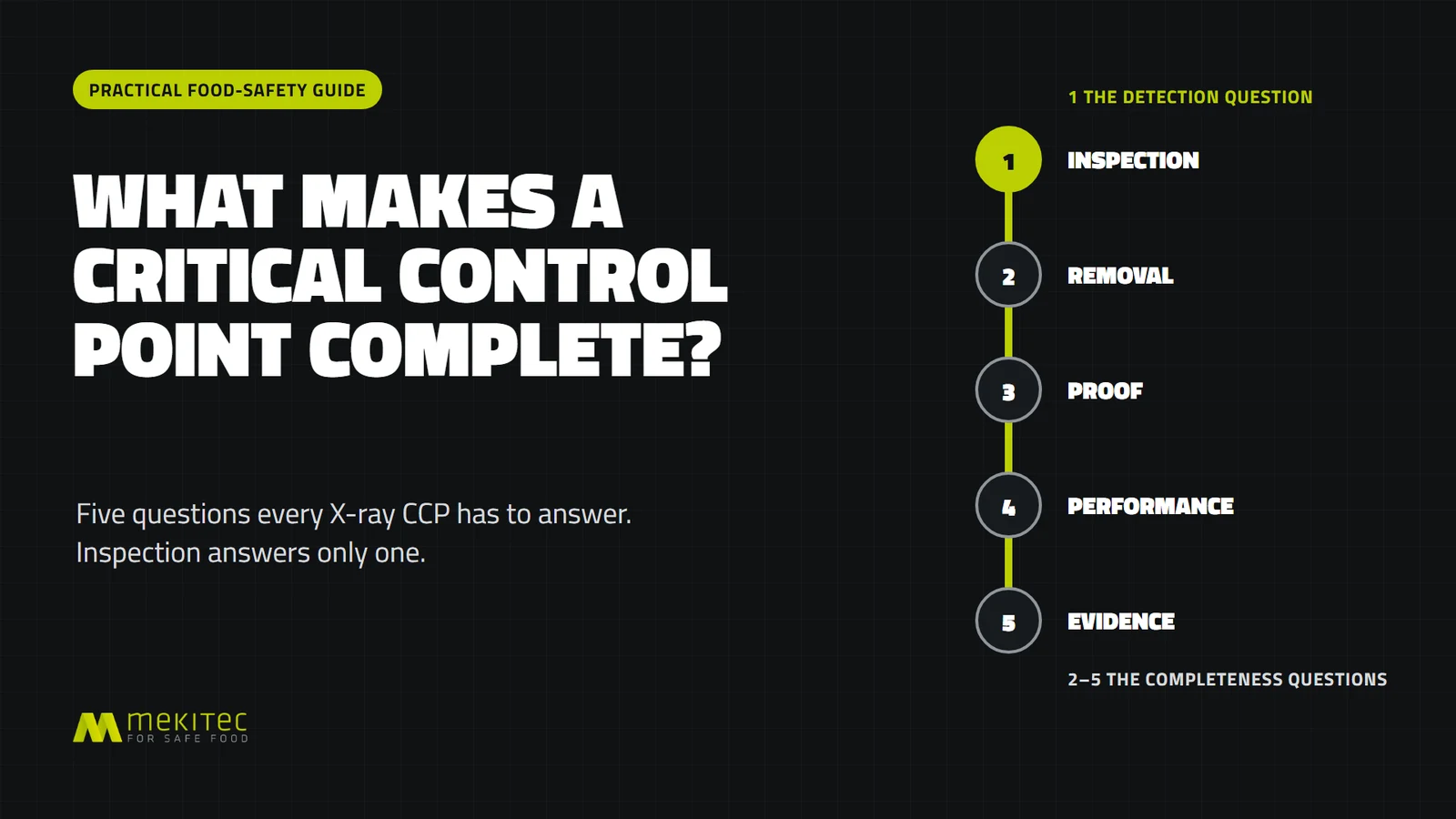
Five questions every X-ray CCP has to answer, and why inspection only answers one.
A Critical Control Point (CCP) is a step in food production at which one or more control measures essential to control a significant food safety hazard are applied within a HACCP system. Installing an inspection machine at that step does not, by itself, make the CCP complete. A complete CCP can inspect the product under validated conditions, remove a suspect pack from the accepted product flow, confirm that the removal happened, show that the control still works, and produce the evidence when someone asks for it.
Mekitec develops and manufactures X-ray inspection systems and software for food producers worldwide. Since the first MEKI installation in 2011, our systems have been used across four continents and in more than 40 countries, and our AI-based X-ray image analysis is covered by a granted US patent. This article is written for the HACCP, quality and engineering teams who have to make an inspection step work as a CCP in practice.
The short answer
- A CCP is a process step, not a machine. The hazard analysis decides which step qualifies.
- Every CCP needs validated critical limits, monitoring, corrective actions, verification and records.
- X-ray inspection can serve as a CCP for relevant physical hazards when that role is justified and validated for the actual product, package, hazard and line.
- Detection is one action inside a CCP, not the whole CCP. Four further questions decide whether the control is complete.
- If the answer to any of the five questions below is "probably" or "somewhere in a folder", that is where the work is, with or without new equipment.
The international foundation is the Codex Alimentarius General Principles of Food Hygiene (CXC 1-1969). The same core sequence appears in FDA HACCP guidance. In the European Union, Article 5 of Regulation (EC) No 852/2004 requires food businesses within its scope to put in place, implement and maintain permanent procedures based on HACCP principles.
Why "we have an X-ray machine" is not the same as "we have a CCP"
On the HACCP flow diagram, an inspection CCP is one box. On the production floor it is a chain of events that has to complete every time, and a body of evidence that has to survive being asked about weeks later.
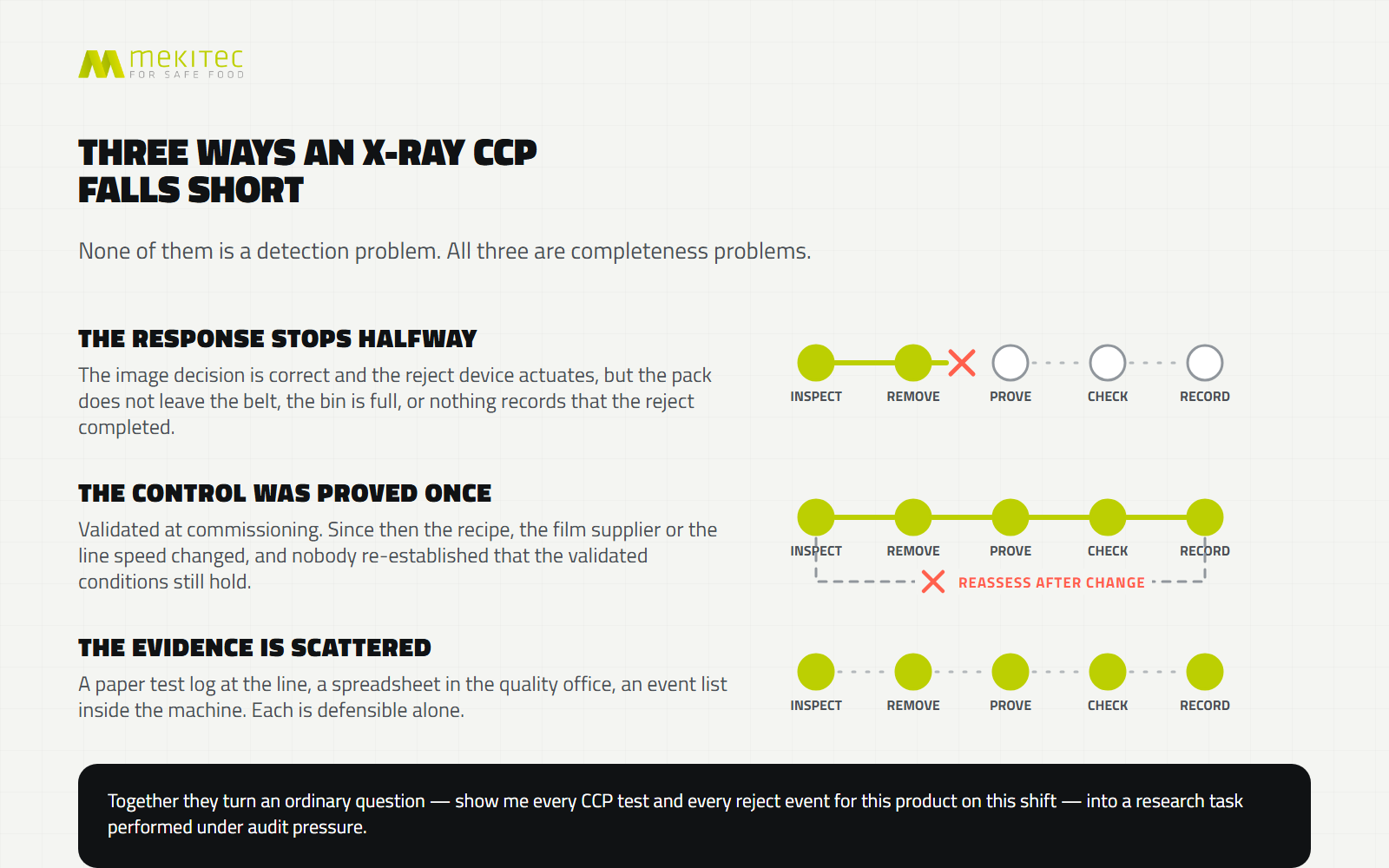
This is where capable food producers fall short. The issue is often not the technology itself, but a requirement scoped as detection when it was actually control plus proof. Three patterns recur:
The response stops halfway. The image decision is correct and the reject device actuates, but the pack does not leave the belt, or the bin is full, or nothing in the system records that the reject completed. Detection happened. Control cannot be demonstrated.
The control was proved once. The system was validated at commissioning. Since then the product recipe changed, the film supplier changed or the line speed was raised for a seasonal run. Nobody documented whether the change could affect food-safety performance or whether revalidation was needed.
The evidence is scattered. A paper test log at the line, a spreadsheet in the quality office, an event list inside the machine. Each is defensible alone. Together they turn an ordinary request, show me every CCP test and reject event for this product on this shift, into a research task performed under audit pressure.
None of the three is a detection problem. All three are completeness problems, and they are what the five questions below are designed to expose.
The five questions: INSPECT, REMOVE, PROVE, CHECK, RECORD
This is Mekitec's practical Complete CCP review framework for an X-ray CCP. It is a way to interrogate an existing control, not a restatement of the Codex HACCP principles and not a substitute for the producer's hazard analysis.
Question 1, INSPECT: Was every in-scope pack inspected under validated conditions?
The requirement is not "the machine was switched on". It is that each product covered by the CCP passed through an operating inspection system, presented the way the validation assumed it would be presented.
The conditions that make an inspection result meaningful are specific: the approved inspection program, product orientation and spacing, line speed, the packaging format actually running, and the settings the validation was performed with. FDA's juice guidance illustrates the expectation with a sector example in which every container is subjected to detection continuously and the device's correct operation is checked at the start of each production day.
Where this fails in practice: product presented outside validated conditions, a recipe running on settings nobody approved, or product bypassing the inspection point during a changeover.
Question 2, REMOVE: Did the suspect pack actually leave the accepted product flow?
A detection decision is information. It becomes control only when the physical product is removed and kept removed.
That means a reject mechanism that works reliably at real line conditions, not only at test-bench conditions. It also means a controlled destination for the rejected pack, so it cannot re-enter the accepted flow before an authorised person has evaluated it and decided its disposition.
Where this fails in practice: marginal reject timing at higher line speeds, a shared or unsecured reject area, or a full bin that quietly stops isolating anything.
Question 3, PROVE: Can you prove it left?
This is the question most often answered with a shrug. Without reject confirmation or equivalent independent evidence, the machine record may show only that a reject was commanded, not that the pack reached the intended controlled reject path.
A properly configured reject-confirmation function closes a specific evidence gap by recording that the monitored completion point in the reject sequence was reached. What it proves depends on sensor placement and logic. It does not replace control of the reject destination, product disposition or the site's defined response to a failed rejection.
Where this fails in practice: reject events logged as "actuated" with no outcome evidence, and no defined action when confirmation fails.
Question 4, CHECK: Do you know the CCP still works, and when it was last checked?
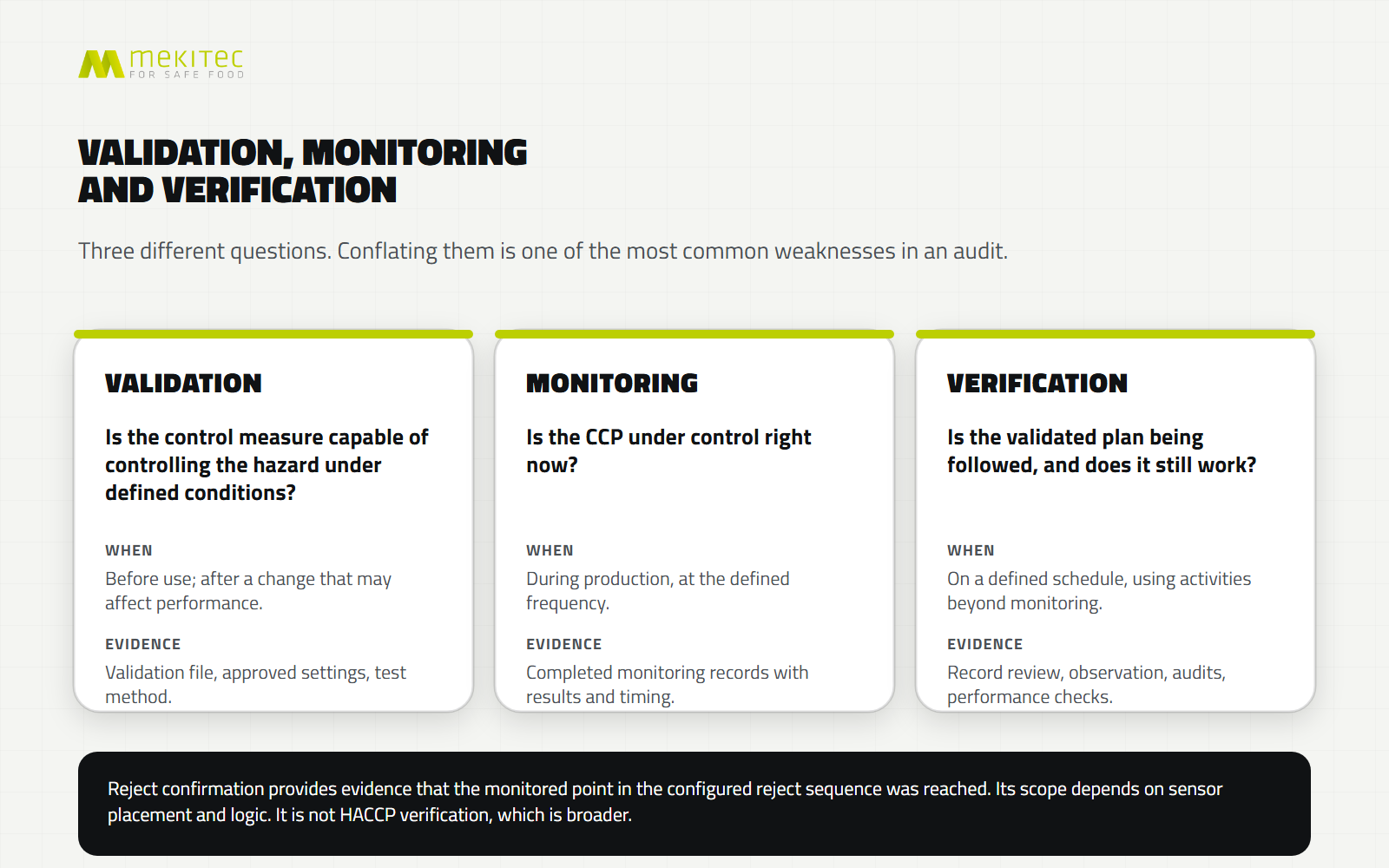
Validation establishes that a control measure is capable of achieving the intended hazard-control outcome under defined conditions. Monitoring assesses whether the CCP is under control during production. Verification confirms that the HACCP procedures are followed and remain effective. The distinction matters, even though factory language varies: some sites call a scheduled test-piece challenge a validation check or validation test.
In this article, application validation means the broader capability study, while a routine CCP performance check means the scheduled operational challenge. Depending on the site's HACCP plan, that check may support monitoring or verification. The written procedure should define what is tested, how often, by whom, where the result is recorded and what happens after a failure.
Where this fails in practice: a handwritten test log with gaps nobody noticed until the audit, checks that continue on schedule after a relevant change or unexplained failure that should have triggered a documented review and, where necessary, revalidation, and test records that cannot be tied to the production they were supposed to cover.
Question 5, RECORD: Can you retrieve the evidence for a defined line, product and production window?
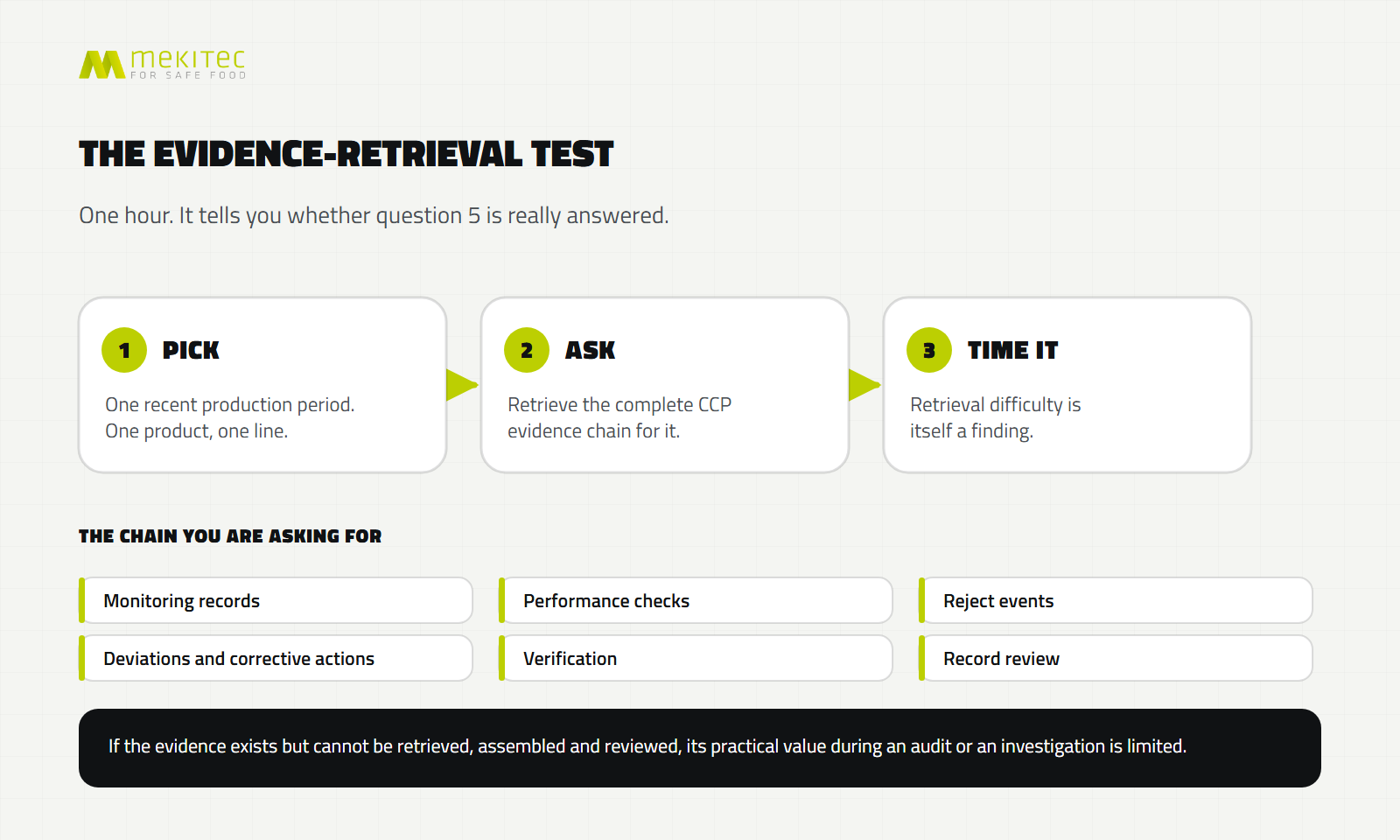
Records are not administration at a CCP. They are the mechanism by which the producer demonstrates that the control worked. If the evidence exists but cannot be retrieved, assembled and reviewed, its practical value during an audit or an investigation is limited.
A useful test takes about one hour. Pick a recent production period and ask the team to retrieve the complete CCP evidence chain for it: monitoring records, performance checks, reject events, any deviations and corrective actions, verification and record review. Time it. Retrieval difficulty is itself a finding.
Where this fails in practice: three systems of record that do not share a key, machine event lists that cannot be filtered the way the question was asked, and reviews that were performed but never recorded as performed.
The five questions against the HACCP requirements
Every row stays with the food producer. Equipment can perform actions and capture evidence inside these rows; it cannot own them.
Can X-ray inspection be a Critical Control Point?
Yes, when the hazard analysis determines that a relevant physical hazard is significant and that X-ray inspection at that step is essential to control it. It is not automatically a CCP because the equipment stands near the end of the line.
X-ray is not automatically the best technology for every product or line. A metal detector may be the right control when the target hazard is metal and product or packaging effects can be managed. However, metal detection is limited to metal, while a validated X-ray application may also detect glass, stone, bone, dense plastic and other sufficiently dense materials. X-ray can also remain viable where conductive packaging, moisture, salt or a large detector aperture restrict metal-detector sensitivity.
The practical comparison is application-specific:
None of this makes X-ray the default. Detectability depends on the foreign object's material, size, shape and orientation, as well as the product, package, line speed and configuration. FDA guidance itself reaches different conclusions for glass control in juice and fish applications, illustrating why the technology must be selected and validated for the actual use case. For a fuller technology comparison, see Mekitec's guide to X-ray inspection and metal detection.
What should an X-ray CCP validation protocol include?
Within the broader validation of the HACCP plan, an X-ray CCP application validation should demonstrate that the complete detection-and-rejection application is capable of controlling the defined physical hazard for a specific product, package, line and operating range. One successful test-piece pass is not enough.
A defensible protocol defines the hazard and intended outcome, the product and package, operating conditions, inspection settings, reject configuration, test pieces, responsibilities and acceptance criteria before testing begins. The study then challenges both detection and successful removal using representative product under actual or appropriately simulated production conditions. Its record preserves the method, settings, results, deviations, limitations, conclusions and authorised approval.
Some producers also use protocol-defined measures such as probability of detection (POD) and false reject rate (FRR). These methods and thresholds must be justified for the application, not copied from another line. Relevant changes or unexplained failures should trigger documented review and, where necessary, revalidation. The detailed study design belongs in the validation protocol rather than in a general article.
Where the five answers come from on a production line
The five questions are answerable with almost any equipment combination, given enough integration work, procedure and manual record-keeping. The practical question for a producer is how much of that work has to be built, and how much arrives already connected.
The following describes how Mekitec's systems address the five questions. None of it replaces the producer's HACCP plan; all of it exists to make that plan executable and demonstrable on a real line.
Questions 1-3: MEKI ONE keeps the physical chain inside one system
MEKI ONE is a compact X-ray inspection system for primary packaged food products, built so that the inspection-and-response chain does not have to be assembled from separate suppliers.
Current public product information lists complete reject confirmation as an option rather than a standard feature, so the supplied reject and confirmation configuration should be confirmed for each application.
The integration consequence is the part that changes project scope. An X-ray CCP assembled from parts is five things to specify, interface, commission, validate and maintain: the detector, the rejector, the reject destination, the confirmation and the reporting. As one system it is a single configuration to validate, one set of operator instructions and one supplier relationship when something in the reject sequence needs attention.
At 1200/1280 x 715 x 2000 mm, MEKI ONE's compact, single-phase format can reduce integration demands and may fit into existing packaging lines without a separate rejector project. Line layout, product dimensions and weight, throughput and site conditions must still be confirmed for the application.
Question 4: MEKI AI Validation Mode digitises an essential part of ongoing CCP control
The weakest link in question 4 is usually the test record, not the test. A check performed correctly and written on a clipboard becomes evidence only if the paper survives, is legible, is attributable and is reviewed.
MEKI AI's Validation Mode does not perform complete application validation on its own. It digitises an essential operational part of the CCP lifecycle: the site-defined routine performance checks used to show that the validated configuration continues to operate as expected. Some factories call these validation checks. Depending on the site's HACCP plan, their records may support monitoring or verification.
Validation Mode can trigger reminders at production start, production end, after a set time or after a set number of products; use visual and audible alerts; require check completion; and record who performed the check, when, with which test card and with what result. If a required check fails, inspection stops and the system remains locked until a user with Quality, Admin or Service credentials clears the condition. The site's procedure still governs affected product and release decisions.
This is the boundary: application validation establishes capability; Validation Mode helps make the recurring check controlled, attributable and retrievable. It supports the validated CCP but does not replace its validation protocol, acceptance criteria or approval.
MEKI AI also addresses false rejections. Mekitec's published figures indicate up to 15% better identification of low-density foreign objects and up to 20% less unnecessary product waste. Actual results depend on the application, production volume and current rejection rate; the commercial model behind these figures is better explored as a separate business-case topic.
MEKI AI is available with Mekitec inspection systems as separately licensed software.
Question 5: MEKI Analytics turns events into retrievable evidence
MEKI Analytics gives quality teams one place to review X-ray CCP activity across connected lines and see whether the connected systems recorded the expected in-scope checks and events for the correct line, product and time window. It centralises production data, keeps time-stamped inspection images and events available for review, and supports monitoring, review and reporting without manual compilation. This helps QA identify missing evidence, investigate deviations and prepare CCP or audit documentation for a specific production period. It also supports production traceability, including narrowing a recall review to the period and product that may actually be affected.
Instead of assembling a paper log, spreadsheet and machine event list, QA can select a connected line and time period and review the available evidence from one place. This shows whether the expected in-scope machine records are present for that production window; it does not establish that every HACCP activity outside the connected systems was completed. The data can also reveal rejection patterns for further investigation.
The boundary, stated plainly. MEKI ONE, MEKI AI and MEKI Analytics do not determine whether a production step is a CCP and do not replace the producer's HACCP plan. The producer remains responsible for the hazard analysis, CCP decision, critical limits, validation, monitoring and verification procedures, corrective actions, training and required records. Detection performance and the appropriate configuration must be established through application-specific testing. Current product information is on the MEKI ONE product page.
Test your own line before you change anything
The third answer to an incomplete CCP is not a product. It is knowing which of the five questions your line currently cannot answer.
Review each question honestly as Yes, Partly, or No for one product on one line:
- Every in-scope pack is inspected under conditions matching the approved validation.
- A suspect pack is removed from the accepted flow and stays controlled until an authorised person dispositions it.
- Completion of the reject action is confirmed, and a failed confirmation triggers a defined response.
- A defined CCP performance check runs at a justified frequency, its results are recorded, and relevant changes or unexplained failures trigger documented review and, where necessary, revalidation.
- The complete CCP evidence chain for a selected shift can be retrieved, reviewed and shown in minutes.
Any "Partly" or "No" becomes an action with an owner and a date. That is the value of the exercise.
Frequently asked questions
Is an X-ray inspection machine automatically a CCP?
No. A CCP is a process step selected through hazard analysis. X-ray equipment can provide the control measure at that step, but installing the machine does not make the step a CCP.
What makes a Critical Control Point complete?
A complete CCP applies a validated control measure to every in-scope product, removes and controls affected product when a limit is not met, confirms that the response occurred, is checked on a justified schedule to show it still works, and produces retrievable records that let a competent reviewer reconstruct what happened.
Is detecting a contaminant enough to complete the CCP response?
No. The process must also control affected product and follow the documented response. In an automated X-ray workflow, rejection, isolation, confirmation and reporting support that response; the site's corrective-action procedure governs it.
What is the difference between CCP validation, monitoring and verification?
Validation establishes, before implementation where possible, that a control measure and its critical limits are capable of achieving the intended hazard-control outcome under defined conditions. Monitoring is the scheduled observation or measurement used to assess whether the CCP is under control during production. Verification uses activities in addition to monitoring, such as record review, observation, audits and calibration or accuracy checks where applicable, to confirm that the HACCP procedures are followed and remain effective.
Is MEKI AI Validation Mode the same as X-ray CCP application validation?
No. Application validation demonstrates that the complete detection-and-rejection control measure is capable of achieving the defined outcome under specified conditions. Validation Mode supports an essential operational layer by scheduling, enforcing and recording the site's routine CCP performance checks. Some factories call these validation checks, but they do not replace the broader application validation.
Does reject confirmation count as HACCP verification?
No. Reject confirmation provides evidence that the monitored point in the configured reject sequence was reached; its evidential scope depends on the supplied sensor placement and logic. HACCP verification is broader and includes record review, observation, audits and periodic reassessment of the system.
How often should an X-ray CCP be tested?
There is no universal frequency. It must be established for the specific HACCP plan and the applicable regulatory, customer and technical requirements. Frequencies quoted in one sector's guidance should not be copied without confirming they apply.
What happens when an X-ray CCP loses control?
The predefined corrective-action procedure should restore process control, identify and segregate potentially affected product, determine safe disposition, investigate the cause where possible, and document the decisions and actions.
Can MEKI ONE operate as part of a CCP?
MEKI ONE can support the equipment layer of an X-ray CCP through X-ray inspection, integrated automatic rejection, an integrated reject bin, configured reject confirmation and system reporting. Current public product information lists complete reject confirmation as an option, so the exact supplied configuration must be confirmed. The producer determines and validates the CCP for its own hazard, product and process.
Can the system produce my CCP records automatically?
It can capture and report the events and checks it performs. MEKI AI Validation Mode schedules and records routine CCP performance checks inside the inspection system. MEKI Analytics centralises X-ray production data so quality teams can monitor connected lines, review evidence for a defined line and time period, and prepare CCP or audit documentation. The complete record set required by a HACCP plan is wider than any inspection system, and the producer decides which records are required, who reviews them and how long they are retained.
Next step
Contact Mekitec to arrange an application review for a specific product and package.
Coming next: the X-Ray CCP Readiness Guide and Checklist will turn these five questions into a practical review your HACCP, quality and production teams can complete together.
Authoritative sources
- Codex Alimentarius Commission. General Principles of Food Hygiene, CXC 1-1969. Revised 2022.
- Codex Alimentarius Commission. Guidelines for the Validation of Food Safety Control Measures, CXG 69-2008.
- U.S. Food and Drug Administration. HACCP Principles & Application Guidelines.
- European Parliament and Council. Regulation (EC) No 852/2004, Article 5.
- U.S. Food and Drug Administration. Juice HACCP Hazards and Controls Guidance: Physical Hazards.
- U.S. Food and Drug Administration. Fish and Fishery Products Hazards and Controls Guidance, Chapter 21: Glass Inclusion.
- Mekitec. MEKI ONE X-ray inspection system.
- Mekitec. MEKI Assurance Intelligence (MEKI AI).
- Mekitec. X-ray vs Metal Detection in Food Safety.
- Mekitec. MEKI Analytics.
Disclaimer
This article is for general educational purposes only. It does not replace product- and process-specific hazard analysis, validation, applicable legal advice, certification requirements or the food producer's HACCP plan. It does not constitute certification or guarantee compliance, audit acceptance or suitability for a particular application.