What Records Should You Be Able to Retrieve for an X-Ray CCP?
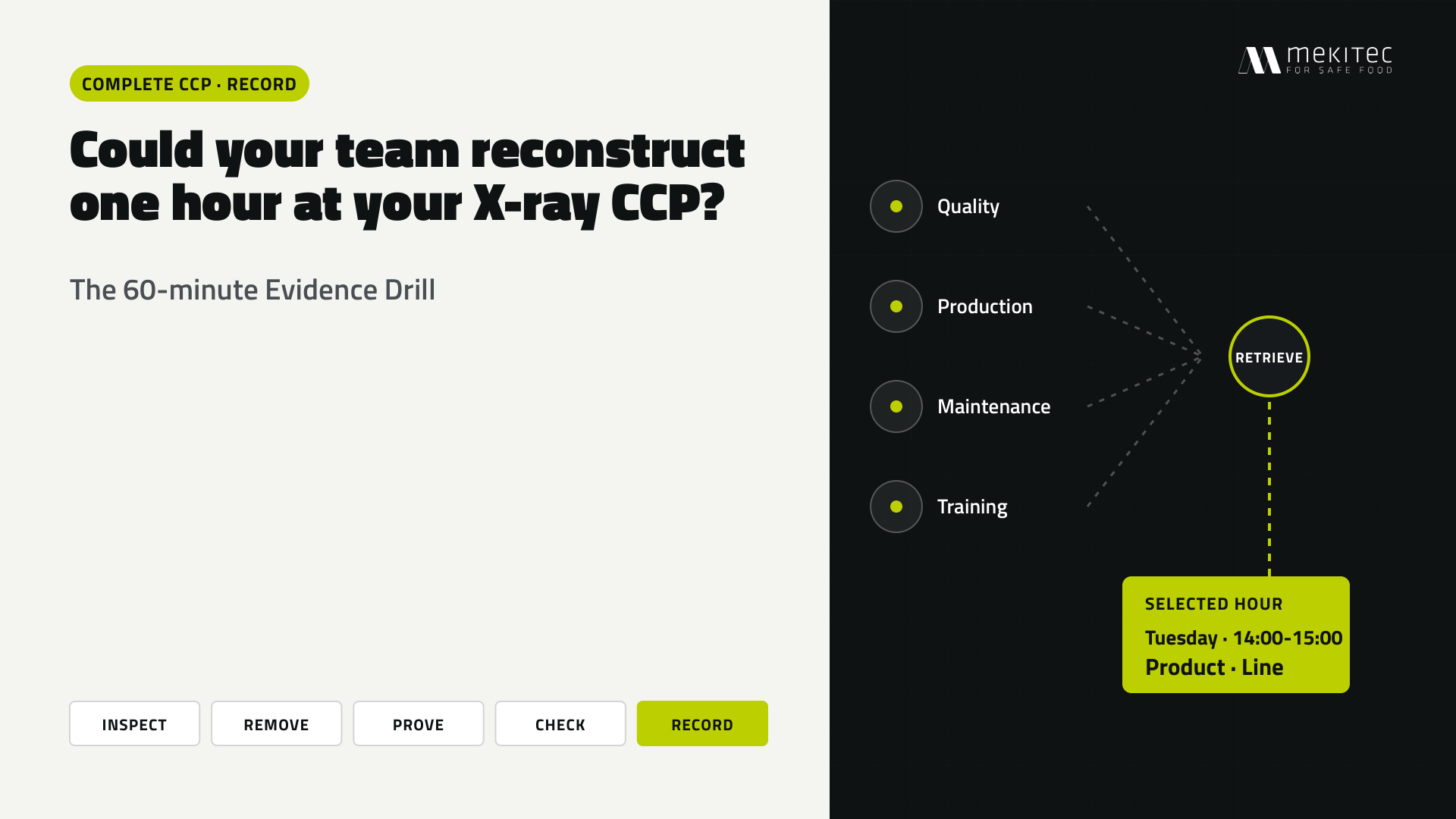
It is Tuesday, 15:05. A customer asks what happened at your X-ray CCP between 14:00 and 15:00. Can your team show the full story within an hour?
Start the clock.
Which product was running? Which inspection program was active? Were the planned checks completed? Did the system reject anything? If it did, was the suspect pack removed from the accepted flow, and what happened to it next?
The machine log answers part of it. The rest sits with quality, production, maintenance and training.
Here is the uncomfortable part: usually nothing is missing. Every record exists, and every one of them has a competent owner. What fails is the connection: nothing ties those records to the same product, line and hour, so an ordinary question turns into a research task carried out under audit pressure.
This article gives your team a practical way to test that connection before someone else does.
The short answer
Your HACCP plan and the legal, customer and certification requirements that apply to your site define the record set. For one X-ray CCP production window, that set usually draws on:
- the approved HACCP plan and the hazard analysis behind it;
- the critical limit and the validation that supports it;
- monitoring records for the window;
- routine performance checks and reject-sequence tests;
- deviations, corrective actions and affected-product decisions;
- verification and record-review evidence; and
- the relevant calibration, training, maintenance and change-control records.
Finding each document is the easy half. The test that matters is whether your team can connect them to the same product, line and production window. To run that test:
- Choose one line, one product and one recent production window.
- Bring together the people who own the records.
- Request the eleven evidence prompts listed below.
- Connect every item to the same product, line and time.
- Stop after 60 minutes and turn every missing or disconnected item into an action.
The result is not another audit checklist. It is a clear picture of how your records work when someone needs an answer.
Why this matters
A Critical Control Point is more than the moment a product passes through an inspection system. The HACCP team must also be able to show how the control was planned, monitored, checked and handled when something went wrong.
The Codex Alimentarius General Principles of Food Hygiene, CXC 1-1969 and FDA's HACCP Principles and Application Guidelines connect monitoring, corrective actions, verification and records. In the European Union, Article 5 of Regulation (EC) No 852/2004 addresses HACCP-based procedures and the documents and records required for businesses within its scope.
Mekitec develops and manufactures X-ray inspection systems and software for food producers worldwide. Since the first MEKI installation in 2011, our systems have been used across four continents and in more than 40 countries, and our AI-based X-ray image analysis is covered by a granted US patent. This article is written for the HACCP, quality and production teams who have to make an inspection step work as a CCP in practice.
One hour, several record owners
Imagine that the X-ray system recorded a reject at 14:17.
The system log can show the event and the active product program. The operator may hold the routine check record. Production may know when the line stopped and which product was placed on hold. Quality may hold the review and final product decision. Maintenance may hold a relevant intervention or setting change.
No single system has to hold every record. The problem begins when the team cannot connect them without relying on memory or on the one person who knows where everything lives.
The Evidence Drill makes that problem visible. It is Mekitec's 60-minute retrieval exercise: the team reconstructs one past production window using records that already exist.
Mekitec's five Complete CCP questions
The Complete CCP framework is Mekitec's practical way to interrogate an existing control. It asks five questions, named INSPECT, REMOVE, PROVE, CHECK and RECORD:
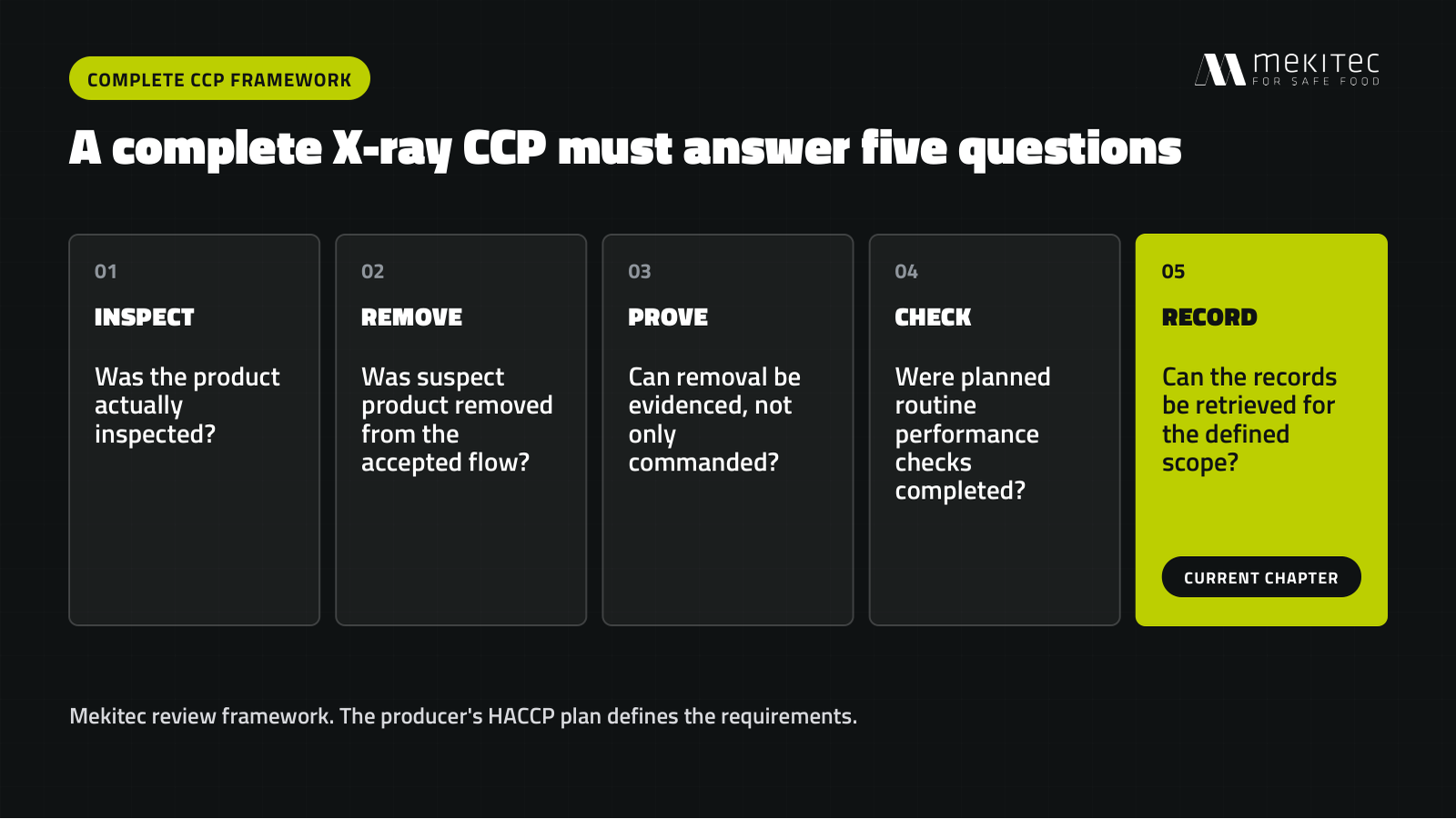
This article develops RECORD, the fifth question. In practice, the records also reveal how INSPECT, REMOVE, PROVE and CHECK were documented.
What is Time to Evidence?
Time to Evidence is the elapsed time a site needs to assemble its site-defined CCP evidence chain for one product, on one line, for one defined production window, using only what already exists.
Time to Evidence is a Mekitec practical review term, not a regulatory metric or a certification requirement. It measures retrieval, not adequacy. It produces no score, pass mark, target, average, benchmark or comparison with another site, and a shorter time is not evidence that the underlying HACCP decisions were sound.
Run it as a fixed exercise:
- use only records that already exist;
- start the timer when the request is made;
- stop after 60 minutes; and
- label anything still missing as not produced within the drill window.
Read the result correctly
The useful output is a record map and an action list, not a grade.
How to run the Evidence Drill in 60 minutes
Choose one recent production window. Include the people who own the records instead of asking quality to retrieve everything alone.
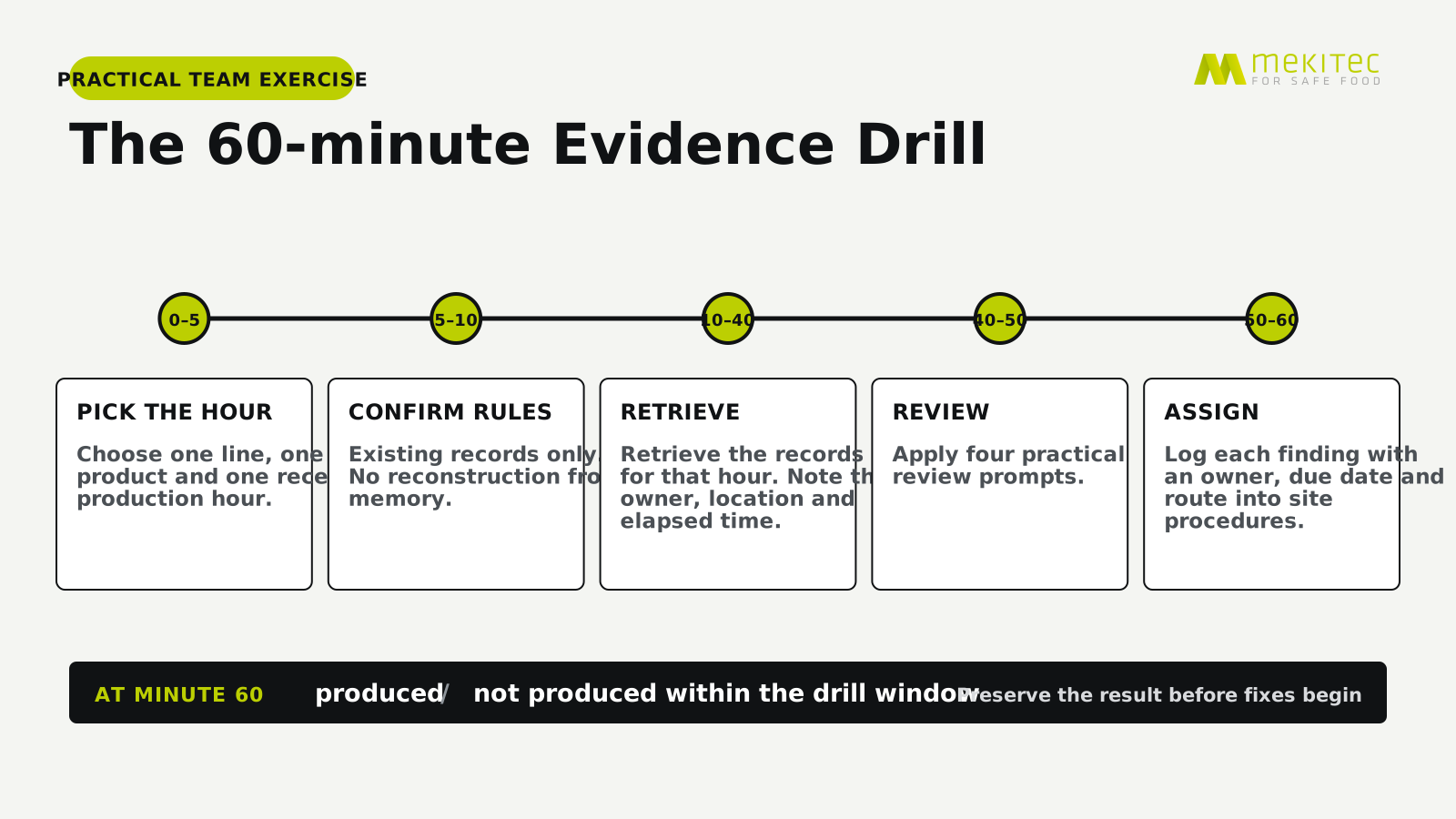
Suggested participants include the HACCP or food-safety lead, line QA, the operator or supervisor from the selected window, production, maintenance, the owner of training records and one facilitator who records the result but does not retrieve documents.
At minute 60, stop. Preserve the result before anyone starts fixing it. The drill should show the retrieval path as it works today.
After the actions are closed, repeat the drill with another suitable product or production window. Compare the new retrieval path with the first one.
Eleven evidence prompts to adapt to the site's HACCP plan
These are the requests to make during the retrieval half of the drill, between minutes 10 and 40. They are prompts, not a universal legal or certification checklist. Adapt them to your HACCP plan: remove what does not apply and add anything your plan or other applicable requirements call for.
Finding a document is not enough. The team also needs to connect it to the production window under review.
Worked example: the 14:17 reject
Take the reject from the start of this article and follow it through the prompts.
Prompt 4 places the pack: the monitoring record shows which product ran on that line at 14:17, under which approved program. Prompt 3 says whether that program and its critical limit were the approved, validated ones on that date, or a version someone changed in between. Prompt 5 shows whether the routine performance check and the reject-sequence test due that shift were actually completed, and what the system did when the test piece went through.
Then the chain leaves the machine. Prompt 6 records the deviation and the immediate correction. Prompt 7 records what happened to the pack itself: where it was held, who evaluated it, what was decided and who approved release or disposal. Prompt 11 answers whether a maintenance intervention or a setting change that morning could have affected the result. Prompt 10 shows whether the operator on shift was trained on the current version of the procedure. Prompt 8 shows whether anyone reviewed the record afterwards, as the procedure requires.
Eight of the eleven prompts touch this single reject event, and only two of them, the monitoring record and the routine check, sit inside the inspection system. That is the shape of the problem: no individual record is missing, but the chain has several owners and no shared key. The drill exists to find out whether your team can assemble it anyway.
Four practical retrieval prompts
Once the records are on the table, ask four simple questions about each one.
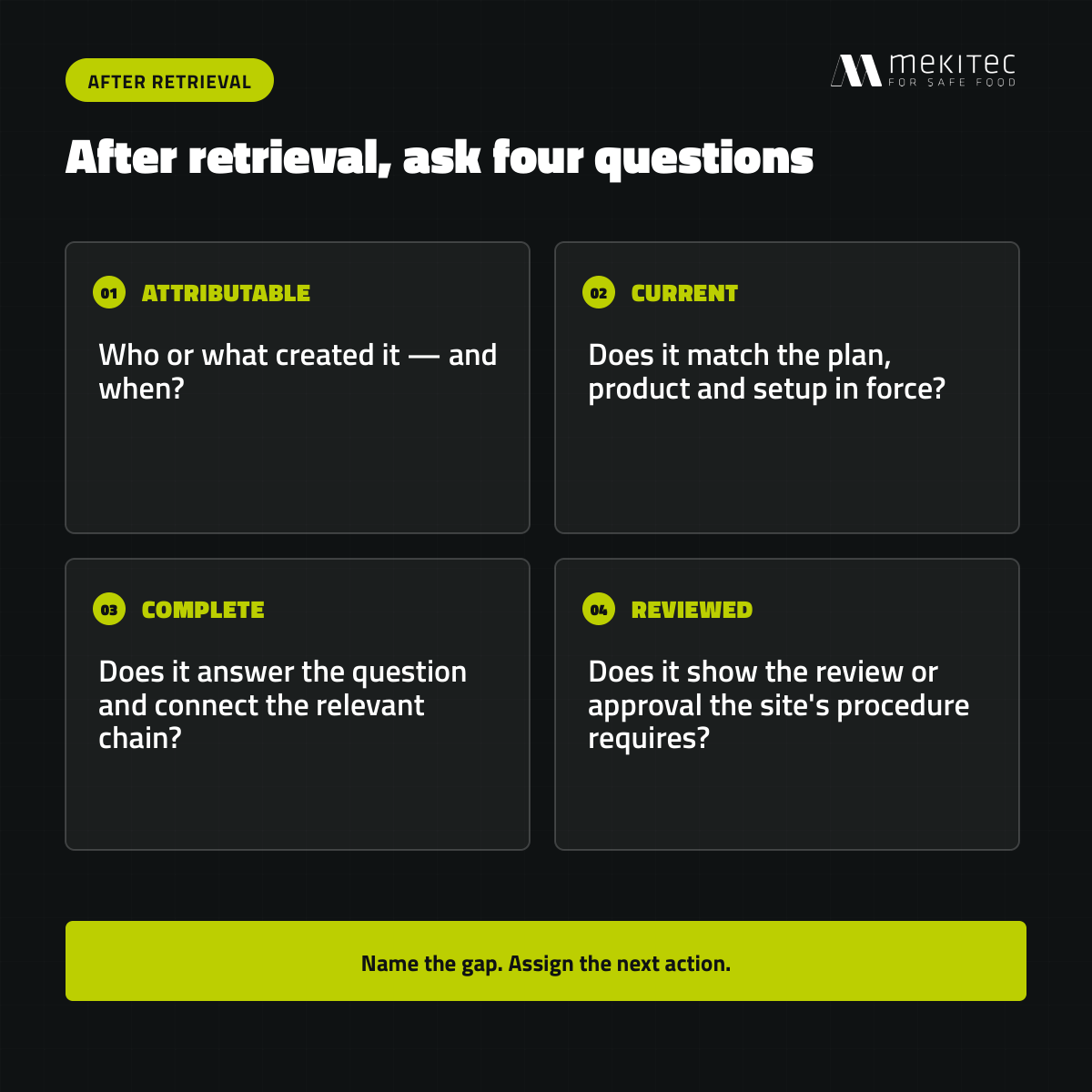
Who created it, and when?
Can the team identify the person who performed the activity or made the entry? If the system created the record, can the team connect it to the correct user, line and event?
Was it current at the time?
Does the record match the HACCP plan, critical limit, product program and equipment setup that were in force during the selected window? An easy-to-find record may still be the wrong version.
Can you follow what happened next?
Does the record answer the question it is meant to answer? For example, can the team follow a reject from the command to the available confirmation evidence, then to product hold and the final decision?
Did the required review happen?
If the procedure calls for a review or approval, does the record show who completed it and when?
Write down the exact gap. “Record missing,” “wrong version” and “final product decision not connected” lead to clearer actions than a percentage score.
Ready to run it with your team? ++Download the X-Ray CCP Readiness Guide (PDF).++ It includes the 60-minute worksheet, the evidence prompts and an action log for assigning every gap.
Turn gaps into actions
Use the same five questions to decide where each finding belongs.
INSPECT
Check whether the product, package, line speed, product program, inspection settings and operating range match the approved plan and validation. If something changed, decide whether it needs documented review or revalidation.
REMOVE
Check reject timing, the reject mechanism, the controlled destination and how rejected or held product was evaluated and handled.
PROVE
State exactly what the supplied sensors and logic confirmed, and where they sit. A confirmation signal normally evidences one monitored point in the reject sequence, commonly that the pack entered the reject container, and not what happened to it afterwards. Check separately whether that container is under controlled access, and what the records show between the confirmation signal and the final product decision.
CHECK
Keep application validation separate from routine performance checks. Codex's Guidelines for the Validation of Food Safety Control Measures, CXG 69-2008 describe validation as obtaining evidence that a control measure is capable of achieving the intended outcome; the routine check is the scheduled activity that shows the validated setup still behaves as expected. Confirm what was checked, how often, by whom, what was recorded and what happened after a failed result.
RECORD
Name the owner and location of each record. Agree on the keys that connect them, such as line, product code, batch and timestamp. Then document review responsibilities and retention requirements.
How many separately specified parts does your reject sequence have?
Before concluding that the drill exposed a record-keeping discipline problem, count the seams.
An X-ray CCP is often assembled from parts: the detector, the reject device, the reject destination, the confirmation sensing and the reporting. Each one is specified, interfaced, commissioned, validated and maintained separately, and they are frequently bought from more than one supplier. Every seam between them is a place where the evidence chain can break quietly. The reject is commanded in one system, the confirmation is sensed by another, and the record that ties both to a product code lives in a third. Nothing failed. The parts were simply never asked to tell one story.
That is why the count matters more than it looks. Ask how many separate configurations had to be validated for this one control, how many operator instructions describe the same reject sequence, and who your team calls when the confirmation stops matching the reject. Where the chain sits inside one system, there is one configuration to validate, one instruction set, and one place to look when something in the sequence needs attention. Where it spans several suppliers, each answer in the drill has to be assembled before it can be reviewed.
Reducing the seam count is not a substitute for the producer's HACCP work, and it does not make an evidence chain complete on its own. It changes how much of the chain has to be built and connected before it can be shown at all. This is the reason Mekitec builds the inspection-and-response chain into one system rather than leaving it to be assembled on the line.
Where Mekitec equipment and software can help
Mekitec's equipment and software support specific parts of the five-question chain. None of it replaces the producer's HACCP plan.
INSPECT, REMOVE and PROVE: MEKI ONE
MEKI ONE supports the physical equipment layer: inspection, rejection, an integrated reject bin, configured reject confirmation and system reporting.
Those are the same five parts counted in the section above, supplied as one system. For the subject of this article that is the practical difference: one configuration to validate instead of five to specify, interface and commission; one set of operator instructions describing the reject sequence; and one supplier to call when the confirmation stops matching the reject. At 1200/1280 × 715 × 2000 mm and on a 110–230 VAC supply, it can also go into an existing packaging line without a separate rejector project. Line layout, product dimensions and weight, throughput and site conditions still have to be confirmed for the application.
Reject confirmation is supplied at more than one level, and the level decides what the record can show. Current public product information lists standard reject confirmation with the integrated rejector, and complete reject confirmation as an option rather than a standard feature. In broad terms, the standard arrangement evidences that a rejected pack reached the monitored point at the reject container and raises a fault when it did not; the fuller arrangement adds controlled access to the container itself. Confirm the supplied sensors, logic and reporting scope for the application before either one is relied on in a HACCP record.
The food producer still needs to establish inspection performance and reject operation for the actual product, package, line and operating conditions.
CHECK: MEKI AI Validation Mode
The food producer defines the purpose, method and frequency of its routine CCP performance check. MEKI AI Validation Mode can schedule, enforce and record that site-defined check inside the inspection system, together with the user, time, test card and result supported by the configured workflow. Where enforcement is enabled, a failed check stops inspection until a user with Quality, Admin or Service credentials clears the condition. The site's own procedure still governs affected product and release decisions.
Scheduling and enforcement are configuration- and licence-dependent. Reminders at production start and end, reminders by elapsed time or product count, audible and visual alarms, and the setting that prevents a due check from being skipped are not all present in every setup, and Validation Mode is enabled per product rather than by default. Confirm what is actually enabled on the specific system before treating any of it as a control in a HACCP plan.
Two naming points are worth stating once, because both appear in the field. Mekitec's product page describes this capability under the broader label Digital Validation; Validation Mode is the name of the guided workflow inside MEKI AI. And the system's own screens call a routine check a validation session. That is the scheduled operational check, not application validation.
Validation Mode does not replace application validation. The two activities answer different questions: validation establishes that the control measure is capable for the application, while the routine check records how the operating setup performed at a planned moment.
RECORD: MEKI Analytics
MEKI Analytics helps quality teams review connected-system activity for a specific production batch, as well as for the correct line, product and time window. QA can then prepare reports from the relevant time-stamped inspection evidence and X-ray images. This can reduce manual work for the machine-generated part of the record chain.
Records held outside connected systems, such as training, corrective actions or a final product decision, still have to be connected through the producer's own process.
Confirm product availability, licensing, compatibility and supplied configuration before commercial use. Mekitec tools support parts of the record chain; the food producer remains responsible for HACCP decisions, corrective actions and final product disposition.
Frequently asked questions
What records does a Critical Control Point require?
The HACCP plan and the applicable legal, customer and certification requirements define the record set. Depending on that scope, the set can include monitoring, deviations and corrective actions, verification and product decisions, supported by the approved plan, hazard analysis, critical limits and validation. Training, maintenance, calibration and change records may also be relevant. The eleven prompts above are a starting point to adapt, not a universal requirement list.
What are Mekitec's five Complete CCP questions?
Mekitec's Complete CCP framework asks five questions about an existing control. INSPECT asks whether the product was actually inspected. REMOVE asks whether suspect product was removed from the accepted flow. PROVE asks whether removal can be evidenced, not only commanded. CHECK asks whether the planned routine CCP performance checks were completed. RECORD asks whether the relevant records can be retrieved for a defined line, product and production window. It is a practical review framework, not a restatement of the Codex HACCP principles and not a substitute for the producer's hazard analysis.
What is Time to Evidence?
Time to Evidence is Mekitec's term for the elapsed time a site needs to assemble its site-defined CCP evidence chain for one product, one line and one production window using existing records. It measures retrieval, not compliance and not the adequacy of the HACCP decisions behind the records. It is not a regulatory metric, and there is no benchmark, average or pass mark for it.
How can a QA team test whether its CCP evidence is retrievable?
Run the exercise on a defined scope instead of auditing the whole system. Pick one line, one product and one recent production window, bring the people who own the records into the same room, and ask for the evidence chain using only records that already exist. Start a timer, stop after sixty minutes, and mark anything still outstanding as not produced within the drill window. Give every gap an owner and a due date and route it through the site's own procedures. Mekitec publishes this as the Evidence Drill, with the worksheets in the X-Ray CCP Readiness Guide.
Is an X-ray system event log automatically a HACCP record?
No. It is equipment-generated data. It becomes useful CCP evidence when the HACCP plan gives it a purpose and the site controls how it is attributed, reviewed, retained and retrieved. The event log is usually one part of the record chain, not the whole story.
What evidence can show that a rejected pack was removed from the production flow?
This is the PROVE question in Mekitec's Complete CCP framework, and no single record answers it. A reject command in the machine log shows that the system decided to reject. A configured reject-confirmation function adds evidence that the pack reached the monitored point in the reject sequence, which is commonly the entry to the reject container; what it proves depends on where the sensors sit and how the logic is configured. Beyond that point the evidence is the site's own: controlled access to the reject container, the hold record, the evaluation, and the documented final decision on the affected product with the name of the person who approved it. A team can usually show the command; the gap is normally between the confirmation signal and the final decision.
Is reject confirmation the same as HACCP verification?
No. Reject confirmation provides evidence about the step monitored by the supplied reject system. HACCP verification is broader and checks whether the HACCP system is being followed and remains effective.
What is the difference between application validation and a routine performance check?
Application validation establishes that the complete control measure is capable for the product, package, line and operating range. A routine performance check records how the operating setup performed at a scheduled moment. They serve different purposes and should not be treated as the same activity. Note that factory and software terminology varies: some sites, and some inspection systems, call the routine check a validation test or validation session.
Does faster retrieval mean better compliance?
No. Faster retrieval shows only that the selected records were assembled more quickly. It says nothing about whether the hazard analysis, critical limits, validation, corrective actions or product-disposition decisions were adequate. A site can assemble an incomplete evidence chain quickly, and a well-run site can be slow because its records are held by several competent owners. Use the drill to find where records live and what is missing, not to produce a time to improve.
What should happen if a required record is missing during the drill?
Write down what was requested and mark it not produced within the drill window. Assign an owner and due date. The HACCP team should then decide what the gap means and whether product evaluation or escalation is needed.
How long should CCP records be retained?
There is no single retention period for every site. Check the legal, customer and certification requirements that apply, together with product shelf life and the site's own procedures.
Can electronic records replace paper records?
They can where the applicable requirements and the site's procedures allow them. Electronic records still need appropriate attribution, integrity, access, retention and review.
Next step
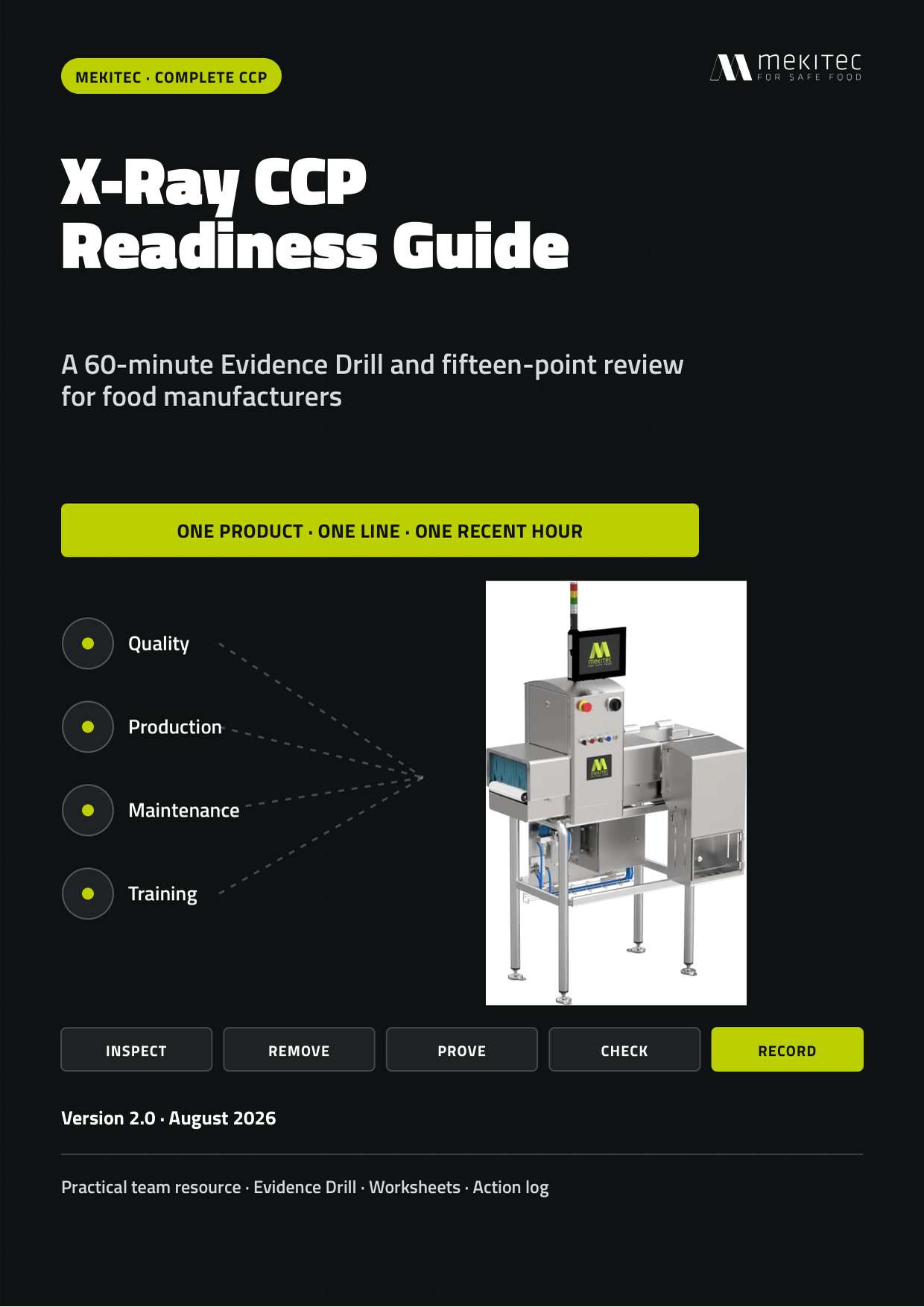
++Download the X-Ray CCP Readiness Guide (PDF)++ and run the Evidence Drill with one line, one product and one production window.
The guide contains the drill worksheets, the five-question review, the fifteen-point checklist and an action log.
If the drill raises questions about the product, inspection settings, reject configuration or what the supplied system records, request a line-specific inspection and records review.
About Mekitec
Mekitec is an X-ray inspection specialist for the food industry, working on what a complete X-ray Critical Control Point actually takes: inspecting the product, removing suspect packs, evidencing that removal, checking that the control still works, and retrieving the records afterwards. Mekitec develops and manufactures the MEKI range of X-ray inspection systems and the MEKI AI inspection software, and publishes the Complete CCP framework, the Time to Evidence review method and the X-Ray CCP Readiness Guide used in this article.
Authoritative sources
- FAO and WHO. General Principles of Food Hygiene, CXC 1-1969. Revised 2022.
- FAO and WHO. Guidelines for the Validation of Food Safety Control Measures, CXG 69-2008.
- U.S. Food and Drug Administration. HACCP Principles and Application Guidelines.
- European Parliament and Council. Regulation (EC) No 852/2004, Article 5.
- Mekitec. What Makes a Critical Control Point Complete?.
- Mekitec. MEKI ONE X-ray inspection system.
- Mekitec. MEKI AI inspection software.
Use and limitations
This article is a practical educational resource, not legal or certification advice. Use the site's HACCP plan and the legal, customer and certification requirements that apply. Product suitability, inspection performance and reject operation must be established for the actual product, package, line and operating conditions.