Switching from Metal Detection to X-ray: A Practical Guide

The switch to X-ray starts before the metal detector leaves your line.
First, decide what the new inspection step should do better.
Moving from metal detection to X-ray can expand the foreign materials you control, make metallized packaging inspectable and add relevant quality checks. Include MEKI AI in the transition where it can improve detection, reduce unnecessary rejects and save time spent handling rejects or recording routine checks.
This guide follows the switch from reviewing today's control and testing your product to installation, validation and handover at a Critical Control Point (CCP). Use it to define the gains, plan the changeover and demonstrate that the new inspection and rejection application works under your production conditions.
Go straight to what you need:
- Define what the switch should improve
- Problems to solve before you choose a system
- Problems to solve before X-ray takes over the CCP
- A step-by-step plan for the switch
Define what the switch should improve
Before you specify the replacement system, agree what the switch needs to improve on your line. These goals guide the application test and the business case:
- Inspect beyond metal. Assess glass, stone, calcified bone and other sufficiently dense foreign materials relevant to your product, alongside the metals controlled today.
- Use the packaging your product needs. X-ray can inspect through foil and metallized film, opening packaging options that can restrict conventional metal detection.
- Keep more good product on the line. Evaluate MEKI AI for improved detection and fewer false rejects. Reducing unnecessary rejection can save product, operator handling time and the cost of investigating good packs.
- Check product quality at the same point. Relevant MEKI AI functions can check counting, filling and missing or excess product. Finding deviations gives production a basis for correcting the process and reducing repeated losses.
- Save operator and QA time. MEKI AI Validation Mode records routine performance checks digitally. Together with MEKI Analytics for reporting, this can reduce manual transcription and the work of assembling inspection evidence.
Demonstrate detection and quality functions on your actual product and pack. Compare good-product rejects, handling time and record-preparation time with today's baseline. Keep food-safety acceptance criteria separate from the financial calculation, and confirm the supplied software functions and configuration in the proposal.
Plan the transition
Organise the switch around four decisions:
- Define the scope. Review today's metal control, the additional hazards or quality needs and the improvements you want to demonstrate.
- Test the proposed configuration. Use your actual product and pack, realistic foreign-material samples and good product. Evaluate the relevant MEKI AI functions and compare the demonstrated gains with the full cost of the change.
- Prepare the changeover. Agree the inspection position, integration, interim control, training and validation of the installed application.
- Hand over and review. Approve the limits, routine checks and records, then measure the agreed improvements after go-live.
Share your product, packaging, current inspection step and desired improvement so we can agree what an application test needs to show.
What changes at the CCP when you switch
- How it detects
- Metal detector: Changes in an electromagnetic field caused by conductive or magnetic material.
- X-ray system: Differences in how much X-ray energy passes through the product, driven by density and thickness.
- Materials to assess
- Metal detector: Ferrous, non-ferrous and stainless steel, with sensitivity depending on the application.
- X-ray system: Metals and sufficiently dense glass, stone, calcified bone and some dense plastics or rubber.
- Weak spots
- Metal detector: Non-metallic hazards; reduced sensitivity from some product effects or conductive packaging.
- X-ray system: Materials barely denser than the product, small or thin aluminium, thick or uneven product areas.
- Packaging
- Metal detector: Foil and some metallized films reduce or prevent conventional detection.
- X-ray system: Can inspect through foil and metallized film; rigid containers need a suitable beam configuration.
- Critical limits usually written as
- Metal detector: Sphere sizes for ferrous, non-ferrous and stainless steel test pieces.
- X-ray system: Sizes per material, set from the hazard analysis and the validation.
- Routine test
- Metal detector: Suitable samples passed with product through the least sensitive part of the aperture.
- X-ray system: Suitable samples placed where detection is hardest in the actual product and pack.
- Typical false-reject causes
- Metal detector: Product effect from wet or salty products, electrical or mechanical interference.
- X-ray system: Density variation, overlapping contents, folds, seals and clips.
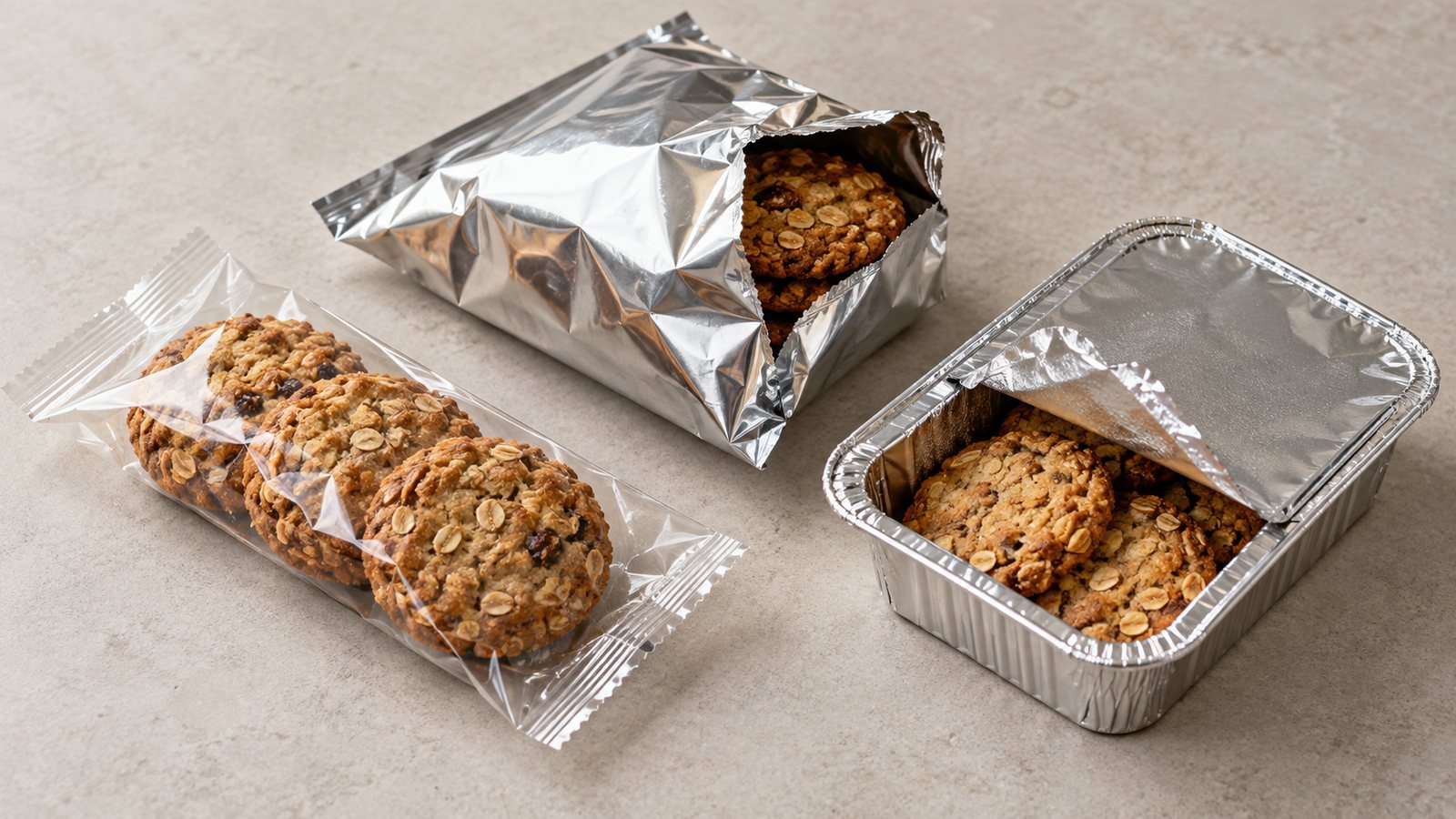
Clear film, metallized film and a foil tray: each format needs its own assessment. Conceptual illustration.
Before you choose the X-ray system
1. The new inspection scope is not defined
The existing metal detection step may be assigned to control metal hazards. Replacing it can change how those hazards are controlled and create an opportunity to address others. The hazard analysis should establish what needs controlling before the technology is chosen.
Without a defined scope, a new capability can be assumed without evidence, or an existing control can be lost.
How to solve it:
- Review realistic foreign materials, sizes and shapes from raw materials, equipment, packaging and the production environment.
- Map the controls for each hazard today and after the switch, including controls elsewhere in the process.
- Define the X-ray scope and acceptance criteria, and agree how unexpected findings will be investigated.
2. X-ray can be weaker than the metal detector on aluminium
A metal detector responds to conductivity and magnetic properties. Aluminium is highly conductive, but its relatively low density can make small or thin fragments difficult for X-ray. The IFS foreign body guideline and the industry's Foreign Material Manual explain this difference. An acceptable stainless steel result does not establish aluminium performance.
How to solve it:
- Include realistic aluminium samples if trays, clips, tools or equipment make it a relevant hazard.
- If the proposed X-ray configuration cannot meet the requirement, retain suitable metal detection or address the source with another justified control.
- Test other low-density materials in the actual product. Name the material, size and position; a general claim of plastic detection does not establish performance.
3. Datasheets and demos do not predict performance on your product
X-ray sensitivity depends on product thickness and variation, packaging and the contaminant's material, size and position. A test piece visible on an empty belt may be difficult to find among overlapping contents. Assess the application with representative product.
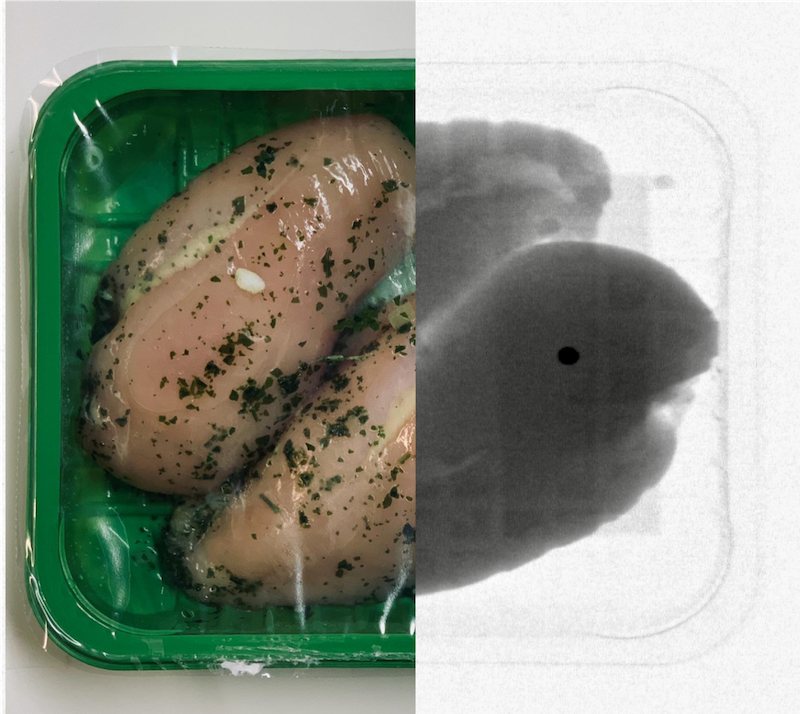
Separate application example: packed chicken and its X-ray image. Mekitec image.
Snackwerks provides a product-specific example. In April 2026, its three MEKI ONE systems underwent validation with its own snacks in metallized packaging and customer-supplied test cards. Each report records ten successful trials: 1.5 mm ferrous, 2.0 mm non-ferrous, 2.0 mm stainless steel and 5.0 mm soda-lime glass were detected. These results apply to the tested products, packs and conditions. Read the Snackwerks validation story.
How to solve it:
- Supply your most difficult products in the actual packaging, with line speed, pack rate, spacing and temperature.
- Agree sample materials, sizes, positions and acceptance criteria. Include good product to measure false rejects, and known quality defects if those checks are part of the project.
- Ask for a report covering settings, conditions, results, failures and limitations.
A supplier's test supports configuration selection. Validate the installed application under the defined production conditions before handover. The Codex General Principles of Food Hygiene distinguish evidence supporting the control design from confirmation that it achieves control in operation.
Tell us which improvement matters on your line. We will agree the scope, samples and criteria for an application test.
4. The X-ray system goes where the metal detector stood
The best location for metal detection may differ from the best location for X-ray. Inspecting after the primary pack is sealed can reduce opportunities for later contamination. A single pack also usually presents less product thickness than a full case. Confirm the position from the hazards and application test.
An upstream metal detector may separately protect a slicer or filler from metal in bulk product. Account for that role before removing it.
How to solve it:
- Update the flow diagram if the step moves, and assess hazards between the old and new positions.
- Check transfers, spacing and light or unstable packs passing the shielding curtains.
- Preserve other required controls and document their roles.
Before X-ray takes over the CCP
5. Existing limits are accepted without evidence for X-ray
An existing test-piece diameter may remain appropriate, but the metal detector's result does not establish X-ray performance. Review the requirement for each material, including any additional hazards. Aluminium performance may differ from stainless steel performance.
How to solve it:
- Review current critical limits and retailer or customer requirements. Establish validated limits for the X-ray application and record their basis.
- Retain suitable existing requirements when the new application demonstrates them. Assess any proposed change deliberately; a technology change alone does not justify relaxing a food-safety requirement.
6. The old test method misses the new application's weakest point
A metal detector is usually least sensitive near the centre of its aperture. For X-ray, the difficult position depends on the product, package and beam geometry, for example among overlapping contents. Review the test method around the new application. BRCGS's Issue 8 FAQ explains why the technologies require different test procedures.
Existing test samples may be usable if their material, size and carrier are suitable. Thin cards are commonly used for X-ray; a wand's carrier can affect the image. The IFS guideline also warns that a glass test sphere denser than the container glass may be detected while real container fragments are missed.
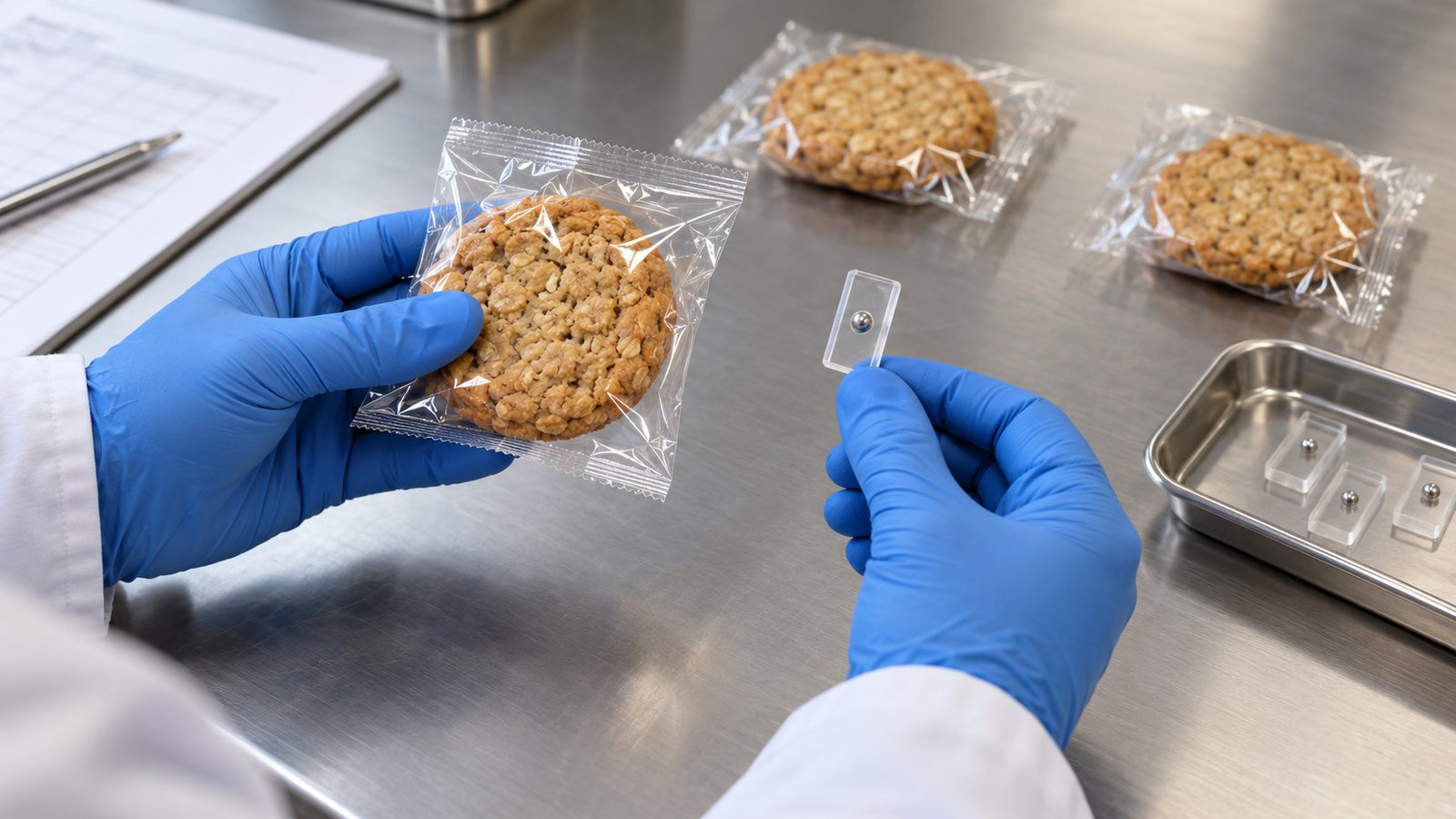
Routine checks use test samples of known material and size, placed in the real product. Conceptual illustration.
How to solve it:
- Confirm sample materials, sizes and carriers, then establish the challenging positions during validation.
- Review check frequency, including starts, ends, changeovers and restarts as applicable. Consider customer requirements and how much product can be identified, held and re-inspected after a failure.
- Test rejection as well as detection, including consecutive test packs where relevant. Mark and account for test packs so none reaches saleable product.
- Use MEKI AI Validation Mode to schedule, enforce and digitally record the site-defined checks on compatible configurations. This can save the time spent copying results into paper logs while keeping the required physical checks in place.
Routine checks confirm that a validated application still performs. They do not replace the validation.
7. The changed reject chain has not been challenged as a whole
New hardware, timing or detection-to-rejection distance can change removal performance. Challenge the complete arrangement; a correct detection cannot control the hazard while the suspect pack remains in the accepted flow.
How to solve it:
- Test detection, rejection, confirmation and containment with real packs across the defined speeds, weights and spacing, including consecutive rejects.
- Challenge applicable faults such as a missed reject, full or open bin and loss of a required utility. Confirm the alarms and defined responses.
- Control access to rejected product and document authorised evaluation and disposition.
8. Production resumes before the new control is approved
A poorly planned changeover can leave production without an approved control. Define suitable control during installation and who authorises the new step before equipment moves.
How to solve it:
- Retain the existing suitable control until handover, use a justified temporary alternative, or hold production until the new control is approved. Define product hold and release rules.
- Where both systems run in parallel, document their roles, review results and investigate rejects. Record the handover date and approver.
- Define the response to downtime after launch. Metal detection covers metal only; establish which products and hazards a fallback can control, and the affected-product scope after a failure.
- Train operators and QA on checks, fault responses and setting permissions. Confirm local radiation-safety duties and the measurements for the supplied system.
- Record the reason for the change, validation evidence, updated procedures and approval.
Regulation (EC) No 852/2004, Article 5, requires businesses within its scope to review their HACCP-based procedures when the product, process or a step changes. Codex identifies new equipment as a reason to review the HACCP system and, where necessary, revalidate the plan. Check the current certification-scheme and customer requirements that apply to your site.
After go-live
9. False rejects come from new causes
X-ray avoids the electromagnetic product effect associated with wet or salty products, but density variation, overlapping contents and packaging features can cause false rejects. Measure the new configuration's result on good product.
MEKI AI can help reduce false rejects, retaining good product and reducing operator time spent separating, reviewing and recording unnecessary rejects. Measure both the packs saved and the handling minutes saved. Tuning must preserve required detection performance. If masking is used, the excluded area is no longer inspected.
Use approved settings covering the product or defined product family, and control changes to them.
How to solve it:
- Measure false rejects across normal variation. Evaluate MEKI AI on the same product alongside the detection requirement.
- Validate detection, false rejects and the inspected area together when masking or settings change.
- Investigate rejected packs under the written procedure; a successful second pass alone is insufficient for release.
- Restrict setting changes and select the approved program at changeover. Review relevant recipe, packaging or line changes and revalidate where necessary.
10. The CCP records no longer match the plan
The new configuration may provide electronic check results, reject events, images or setting changes. Confirm exactly what it records. If the plan still describes only the old paper workflow, useful evidence may be disconnected from the records QA needs.
MEKI AI's digital check records and reporting through MEKI Analytics can reduce the time spent transcribing results and gathering inspection data for QA review. Define which tasks each tool supports and test the complete workflow, including the records the site still needs to add.
How to solve it:
- Define record owners, storage, retention and review for monitoring, checks, rejects and corrective actions. Confirm electronic workflow requirements against your plan.
- Confirm what images and events the supplied configuration retains; do not assume an image exists for every pack.
- Retrieve the required evidence for one line, product and time window, and measure preparation time. Use the CCP records and evidence retrieval guide for the detailed exercise.
A step-by-step plan for the switch
- Define the change. Who leads: HACCP team. Done when: the hazards, inspection point, intended improvements and acceptance criteria are agreed.
- Test the application. Who leads: QA with the supplier. Done when: the report covers the hardest products, agreed samples, false rejects, relevant quality checks and limitations.
- Plan the changeover. Who leads: QA, engineering and production. Done when: the interim control, hold-and-release rules, training and handover date are agreed.
- Install and validate. Who leads: QA and engineering with the supplier. Done when: validation covers detection, rejection, confirmation and failure responses on the installed line.
- Update the HACCP plan. Who leads: HACCP team. Done when: critical limits, routine checks, corrective actions and records are approved.
- Hand over the CCP. Who leads: QA. Done when: the approval is recorded and the metal detector's role is removed or redefined.
- Review after go-live. Who leads: QA with production. Done when: check results and records are reviewed, and the agreed improvements are measured against the baseline.
The switch through the five CCP questions
Mekitec's Complete CCP framework asks five questions of every X-ray CCP. A technology switch reopens all five at once.
- INSPECT: Was the product actually inspected? What the switch changes: hazards, inspection point, critical limits and product settings. Problems above: 1 to 5 and 9.
- REMOVE: Was the suspect product actually removed from the flow? What the switch changes: reject hardware, timing and the secure bin. Problems above: 7.
- PROVE: Can removal be evidenced, not just commanded? What the switch changes: reject confirmation and the response when it fails. Problems above: 7.
- CHECK: Were the routine CCP performance checks completed as planned? What the switch changes: test samples, positions and timing. Problems above: 6.
- RECORD: Can the records be retrieved for a defined line, product and time window? What the switch changes: where records are kept and how they are found. Problems above: 10.
The changeover itself, problem 8, touches all five.
What the switch costs beyond the system
Ask for a proposal that covers the work, not only the equipment:
- Application testing, configuration and support during validation.
- Conveyor integration, the reject arrangement, utilities, cleaning and access.
- Operator and QA training, and production time during the changeover.
- Test samples for the new routine checks.
- Service, preventive maintenance, spare parts and software terms.
- Local radiation-safety duties, which differ by country.
Questions teams ask before switching
Is switching worthwhile if our metal detector works well?
Yes, when your line could benefit from additional hazard control, metallized packaging, relevant quality checks or less avoidable waste and manual work. A metal detector may meet today's metal requirement while X-ray offers a broader inspection role. Test the opportunity with your product and packaging, then compare the demonstrated gains with the full cost of the change.
Can we keep the same critical limits and test samples?
Possibly. Confirm that the limits remain appropriate and demonstrate performance on the installed X-ray application. Check each sample's material, size, carrier and position. The existing dimensions may be suitable, while the carrier or test procedure needs to change. Your HACCP team approves the resulting limits and routine checks.
Can both systems stay on the line?
Yes, if the hazard analysis supports their roles. The metal detector may remain a control for a particular hazard or protect equipment upstream. Define each role, inspection point and failure response in the plan, and check customer requirements before removing an existing control. The HACCP team determines which process step is a CCP.
How Mekitec supports the switch
Mekitec develops and manufactures X-ray inspection systems and software for food producers worldwide. A switch starts with an application test on your product, packaging and target foreign materials, with a report that states the test conditions and the limits of the result.
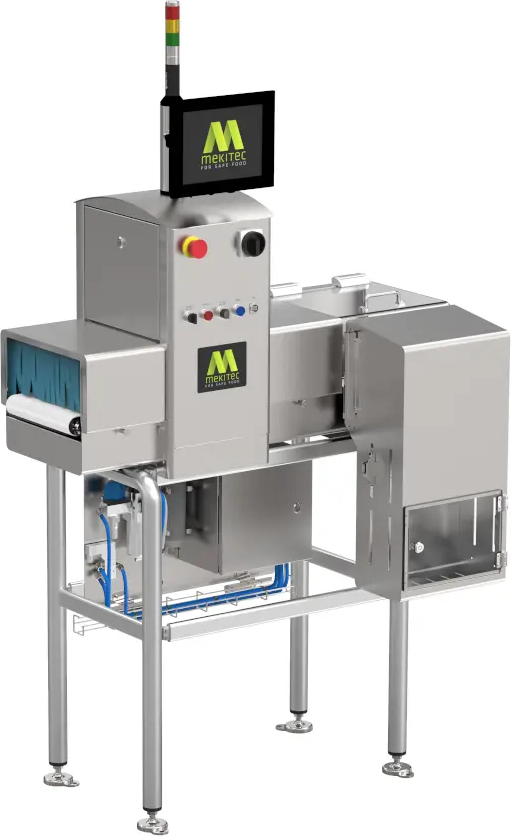
MEKI ONE combines inspection, automatic rejection, a reject bin, standard reject confirmation and production reporting in one frame.
MEKI ONE: inspection and rejection in one frame
MEKI ONE, for primary packaged food, combines inspection, automatic rejection, a reject bin, standard reject confirmation and production reporting in one frame. Full reject confirmation is an option, so confirm the supplied configuration for your line. It supports the INSPECT, REMOVE and PROVE questions.
MEKI AI: improve detection and reduce avoidable loss
MEKI AI is Mekitec's premium X-ray inspection software for compatible Mekitec systems. Its AI-powered image analysis can improve foreign-object detection and reduce false rejects. Fewer unnecessary rejects mean more good product retained and less operator time spent handling it. Demonstrate those gains on your own products as part of the application test.
MEKI AI also supports relevant product-quality checks, including counting, filling and missing or excess product. Agree which functions address your production losses and confirm their performance and availability for the proposed configuration.
Validation Mode: routine checks with digital records
Validation Mode is a function within MEKI AI. It schedules, enforces and records the site-defined routine CCP performance checks, reducing manual recording work. It supports the CHECK question and does not replace application validation.
MEKI Analytics: less work assembling inspection evidence
MEKI Analytics helps QA review connected-system activity for a defined line, product and time window and prepare reporting from time-stamped evidence. Its connection with MEKI AI can reduce the work of finding and assembling inspection records. It supports the RECORD question.
None of these replaces the producer's hazard analysis, the validation of the installed application or the HACCP plan. Software availability, licensing and compatibility are confirmed in the proposal.
Plan your switch with Mekitec
You do not need a finished specification to start. Tell us:
- which products and packaging run on the line;
- which foreign materials are in your hazard analysis;
- where the metal detector sits today;
- which improvement you want the switch to deliver.
We will agree what an application test needs to show before any equipment decision is made.
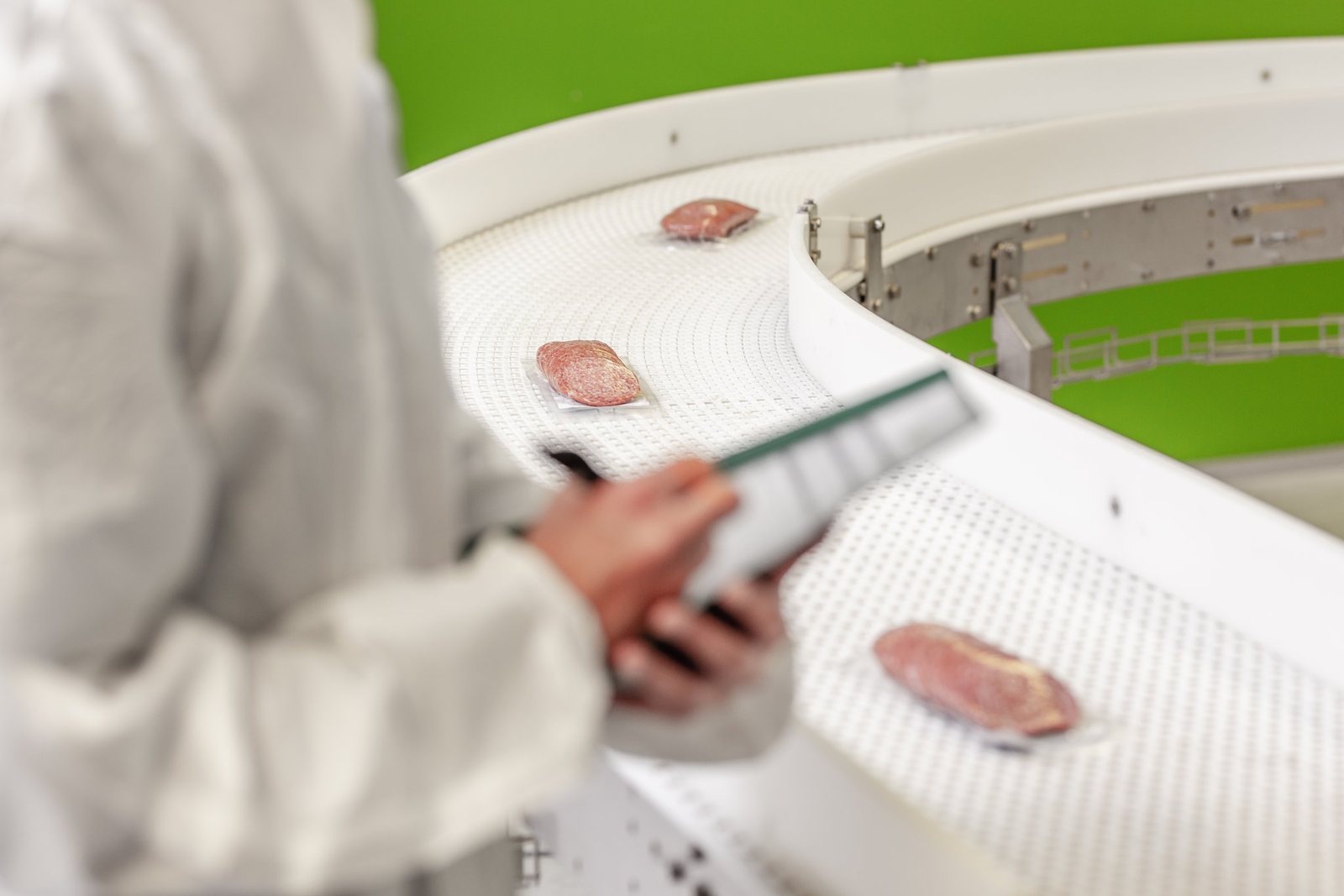
Application testing on a conveyor. Photo: Mekitec.
Sources
- Codex Alimentarius Commission. General Principles of Food Hygiene, CXC 1-1969, revised 2022.
- European Parliament and Council. Regulation (EC) No 852/2004 on the hygiene of foodstuffs, Article 5.
- IFS. Guideline for an effective Foreign Body Management, Version 3.
- The Meat & Poultry Industry Foreign Material Manual, 2021.
- BRCGS. Food Safety Issue 8 FAQs, August 2020. Historical explanation of the differences between metal detector and X-ray testing procedures.
- Mekitec. How Snackwerks validated X-ray inspection for metallized snack packaging.
- Mekitec. MEKI AI food X-ray inspection software.
- Mekitec. MEKI Analytics.
This guide is general information. It does not replace your hazard analysis, validation, legal requirements or certification-scheme requirements.